Master the Month-to-Month Lease: A Strategic Guide for Landlords and Renters


Traditional fixed-term leases lock you into rigid 12-month commitments, but month-to-month leases swap long-term stability for maximum flexibility. This fast-paced rental structure allows housing arrangements to adapt quickly to changing job, financial, or personal timelines.
However, moving away from standard leasing requires weighing higher vacancy risks and premium rent pricing against the freedom to walk away on short notice. We break down the essential pros and cons of month-to-month leases, the financial trade-offs, and the step-by-step documentation processes that both landlords and renters need to protect themselves.
What Is a Month-to-Month Lease?
A month-to-month lease is a rental agreement that automatically renews at the end of each month until either the landlord or the tenant provides written notice to terminate. Unlike fixed-term leases, it has no predetermined end date, which offers ongoing flexibility for both parties.
This lease arrangement typically originates in one of two ways. First, a landlord and tenant can explicitly sign a new month-to-month rental agreement from the very start of the tenancy. Second, the arrangement can form when a standard fixed-term lease expires, and the tenancy converts (or “holds over“) into a month-to-month arrangement per the lease’s holdover clause or state law.
What Are the Advantages of Month-to-Month Leasing for Tenants?
The core benefit of a month-to-month rental agreement for tenants is unparalleled flexibility. Short-term renting options like month-to-month allows tenants to move without breaking a fixed lease to easily adapt to sudden life alterations.
A flexible lease structure proves exceptionally valuable for renters in the following circumstances:
- Job relocations: Professionals taking on temporary work assignments, short-term internships, or transitional living roles rely heavily on flexible lease terms.
- Neighborhood testing: Renters can explore a completely new city or neighborhood before executing a long-term commitment.
- Homebuying transitions: Buyers waiting to close on a home purchase can utilize interim housing without being locked down.
- Personal life changes: Recently separated or divorced individuals in a state of transition can secure immediate, temporary housing.
- Variable schedules: College students or seasonal workers can align their housing directly with shifting academic or employment calendars.
Furthermore, a month-to-month lease usually requires a very short notice period to end the tenancy. Renters are not locked into financial obligations for months on end if their personal plans change unexpectedly.
Tenants also gain the unique ability to renegotiate their lease terms more frequently, though this structural feature cuts both ways, as it simultaneously opens the door to more frequent rent increases.
What Are the Advantages of Month-to-Month Leasing for Landlords?
A month-to-month lease serves as an excellent property management strategy for independent landlords rather than just a fallback plan. You can easily move tenants out faster when necessary and make it substantially easier to address or remove problem tenants sooner.
The main advantages of offering month-to-month leases are:
- Tenant trial periods: A short lease functions as a practical trial period to evaluate new tenants. If the tenant proves reliable, the landlord can confidently offer a longer-term lease; if issues arise, the arrangement ends naturally.
- Rent optimization: This type of tenancy allows you to adjust rent prices quickly to capture rapid market updates. This positioning is especially powerful for optimizing rental income in highly appreciating real estate markets.
- Property planning flexibility: Managing a property on a month-by-month basis makes it much easier to execute building renovations, change long-term property plans, or put the home on the sales market. Without the barrier of an active annual lease, owners can use or occupy the property themselves much more easily.
- Rent premiums: Landlords can almost always charge a higher monthly rent premium to compensate for providing structural rental flexibility.
What Financial Factors Impact Month-to-Month Tenancies?
Landlords frequently charge a month-to-month rent premium that adds roughly 20% to 40% more to the monthly cost compared to a fixed term lease. This pricing gap functions as an excellent revenue opportunity for DIY landlords, but represents a serious financial cost consideration for tenants to navigate.
Financial Comparison: Month-to-Month vs. Fixed-Term Leases
| Financial Factor | Month-to-Month Lease | Fixed-Term Lease (12 Months) |
|---|---|---|
| Monthly Rent | Typically 20-40% higher | Lower, locked-in contract rate |
| Income Predictability | Less predictable | Stable and forecastable |
| Vacancy Risk | Higher (tenants can leave on short notice) | Lower |
| Ability to Raise Rent | Frequent, with proper notice | Only at renewal |
| Turnover Costs | Higher (cleaning, repairs, re-listing) | Lower |
Opting for a month-to-month lease structure can generate less predictable overall rental income for property owners. As a landlord, you face a significantly elevated vacancy risk when tenants possess the legal right to move out on short notice. Because of this volatility, consider building a robust vacancy buffer directly into your financial planning spreadsheets.
For tenants, long-term leases undeniably offer lower monthly costs and superior housing stability. Renters who specifically prioritize flexibility must purposefully budget for the monthly premium and prepare for the reality of potential rent increases.
Additionally, these rentals often have higher operating costs due to the demands of staging furnishings and buying turnover supplies.
What’s the Difference Between Month-to-Month and Fixed Leases?
| Feature | Month-to-Month Lease | Fixed-Term Lease |
|---|---|---|
| Duration | Renews monthly; no set end date | Set period (typically 6–12 months) |
| Flexibility | High for both parties | Low until lease expires |
| Monthly Rent | Often 20–40% higher than market baseline | Typically lower, stable, locked-in rate |
| Income Stability | Less predictable over the calendar year | Highly predictable and forecastable |
| Vacancy Risk | Elevated due to rapid turnaround potential | Significantly lower over the lease term |
| Turnover Costs | Higher due to frequent occupancy shifts | Lower due to extended residency |
| Rent Adjustments | Possible each month with proper written notice | Only allowed at the official renewal period |
| Termination | Requires short notice (typically 15–30 days) | Strict early termination penalties apply |
| Best For | Transitional situations and uncertain plans | Stability-seeking tenants and landlords |
Traditional long-term rentals generally involve a locked-in 12-month lease or longer. In contrast, a month-to-month agreement automatically rolls over and renews every 30 days until one of the parties actively chooses to end it.
Annual leases inherently prioritize long-term financial predictability and physical housing stability, while month-to-month leases purposefully prioritize adaptability over everything else.
What Operational Challenges Come With Month-to-Month Tenancies?
Frequent tenant turnover dramatically escalates long-term maintenance costs and cleaning bills. Short-term rentals naturally require more frequent repairs, paint touch-ups, and deep cleans between consecutive occupants.
If you plan to offer month-to-month tenancies, prepare for the hands-on realities of executing the property management cycle several times a year. Select counties and states also have specific laws on how short-term arrangements must be approached to remain compliant. For that reason, thoroughly familiarize yourself with local landlord-tenant laws and required notice periods before offering this type of tenancy.
What Legal and Notice Requirements Govern Month-to-Month Leases?
Landlords are typically required by law to provide a formal 15 to 30 days’ notice of non-renewal to legally end a tenancy. However, notice period requirements vary significantly depending on state statutes and local municipality ordinances.
Both landlords and tenants must carefully verify their local rental laws to avoid costly legal errors. Important notices to be aware of are the following:
- Notice of Non-Renewal: A formal written communication from a landlord or tenant stating their intent to end a month-to-month lease, typically required 15 to 30 days before the next rental period begins. Understanding the specific legal guardrails governing month-to-month tenancies prevents unexpected compliance issues:
- Notice periods: While most states require a baseline 30 days’ notice, some jurisdictions require as few as 15 days or as many as 60 days. As a landlord, it’s always best to explicitly write the exact required notice period directly into the lease clauses.
- No-cause termination restrictions: Certain jurisdictions heavily restrict or outright prohibit no-cause terminations. In these tenant-protection markets, a landlord cannot simply end a month-to-month lease without presenting a legally qualifying reason.
- Rent increase notice rules: Landlords must typically provide a rent increase letter before raising the rent price on a month-to-month lease. The required notice period window is dictated by state law.
- Formal eviction rules: Utilizing a month-to-month lease structure does not bypass formal eviction procedures. If a tenant refuses to vacate the property after proper notice has been served, the landlord must still navigate the official court eviction process.
Visit our Resources page to download our free form templates.
What Are Common Mistakes Landlords Make in Month-to-Month Leases?
Because month-to-month agreements lack a definitive long-term end date, independent landlords often treat them too casually. This relaxed approach frequently leads to expensive disputes or operational headaches.
- Failing to put the agreement in writing: Relying on verbal agreements or a simple handshake is a recipe for disaster. A valid lease must always be structured in writing to ensure rules, late fee automations, and property expectations are contractually enforceable.
- Neglecting thorough tenant screening: Landlords often assume a shorter term lease reduces their risk, skipping proper tenant screening. A bad tenant can cause immense damage or refuse to pay rent in just a few weeks; a short lease term is never an acceptable substitute for comprehensive, TransUnion-powered tenant screening.
- Ignoring localized notice requirements: A month-to-month lease cannot be canceled on a whim; in fact, doing so can pose a huge legal problem. It’s important to always give proper advance written notice (typically 15 to 30 days, depending on the state) before the next rental period begins.
- Improperly executing rent adjustments: While month-to-month leases offer incredible pricing flexibility, landlords cannot change the rent amount without providing advance written notice as required by local state laws.
- Forgetting local no-cause termination laws: Assuming you can always end a monthly agreement without a reason is a common pitfall. A growing number of tenant-protection markets legally prohibit no-cause non-renewals, requiring landlords to provide a contractually qualifying reason to terminate the tenancy.
Protect your rental business with a state-specific, lawyer-reviewed lease agreement template that has all the locally required information.
When Should You Choose a Month-to-Month Lease?
A month-to-month lease is a strategic tool tailored for specific scenarios rather than being universally superior or inferior to a fixed-term annual lease.
Tenants should consider a month-to-month lease when:
- They are relocating for a new job or handling a temporary work assignment that requires short-term housing.
- They want to carefully explore an unfamiliar city or neighborhood before committing to a permanent location.
- They are actively buying property and need temporary housing while waiting to close on a home purchase.
- They have fluid, uncertain lifestyle plans and heavily prioritize the ability to vacate on short notice.
Landlords should consider a month-to-month lease when:
- They anticipate selling the rental property, completing heavy structural renovations, or changing their real estate plans in the near term.
- They want to carefully evaluate a renter’s reliability through a tenant trial period before offering a long-term contract.
- They operate inside a fast-moving market with rising rents and want the freedom to adjust pricing frequently.
- They manage furnished properties or vacation rental properties, where typical short-term leases last between one to six months.
Conversely, avoiding a month-to-month contract is best if predictable income, minimal turnover work, and long-term tenant stability are the primary goals. If a tenant wants a locked-in rental rate and absolute housing security, an annual fixed-term lease is a much better fit.
How to Create a Month-to-Month Lease With Avail
Building a legally sound month-to-month lease agreement shouldn’t require complex legal software or expensive attorney consultations. Avail streamlines property management by providing state-specific, lawyer-reviewed lease agreement templates that work perfectly for both long-term fixed arrangements and highly flexible month-to-month tenancies.
1. Select Your State-Specific Template
Rental laws vary wildly by state and municipality. When you use Avail, the platform automatically draws from templates developed with local rental regulations in mind, automatically incorporating all state-required disclosures and legal clauses.
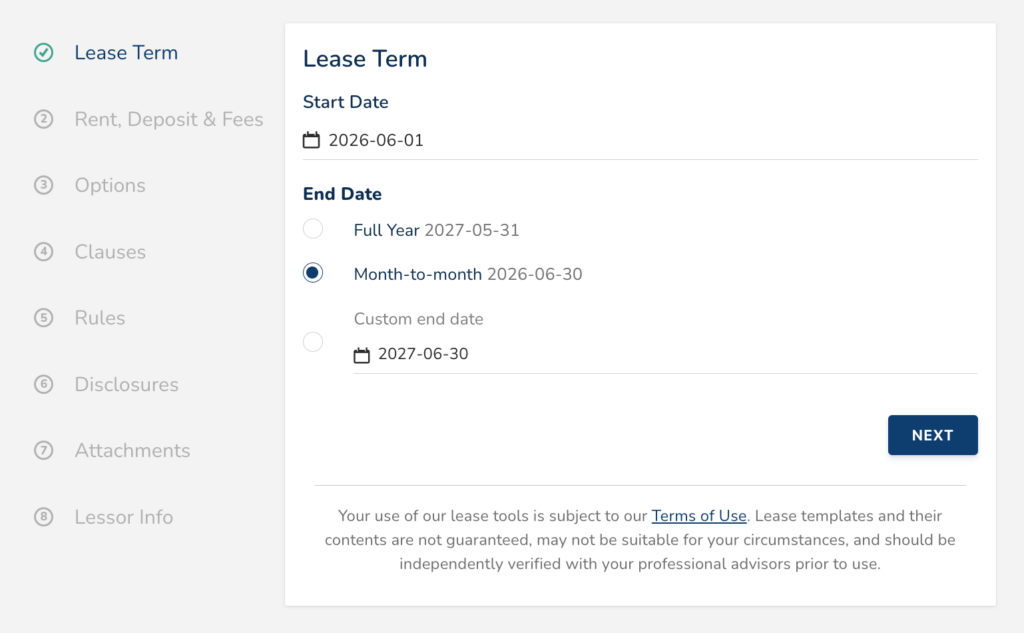
When creating a new lease, select the “Month-to-month” option. From there, add the relevant information necessary such as rent price, fees the tenant will have to pay, if pets are allowed, and more.
2. Customize to Meet Your Needs
While the base Unlimited plan provides everything you need to create a compliant lease for free, upgrading to Unlimited Plus lets you add fully customized clauses, unique local rules, or property-specific constraints to your templates. As you add all the requested information, you can then add custom clauses and make adjustments to the template to ensure it’s specific to your needs.
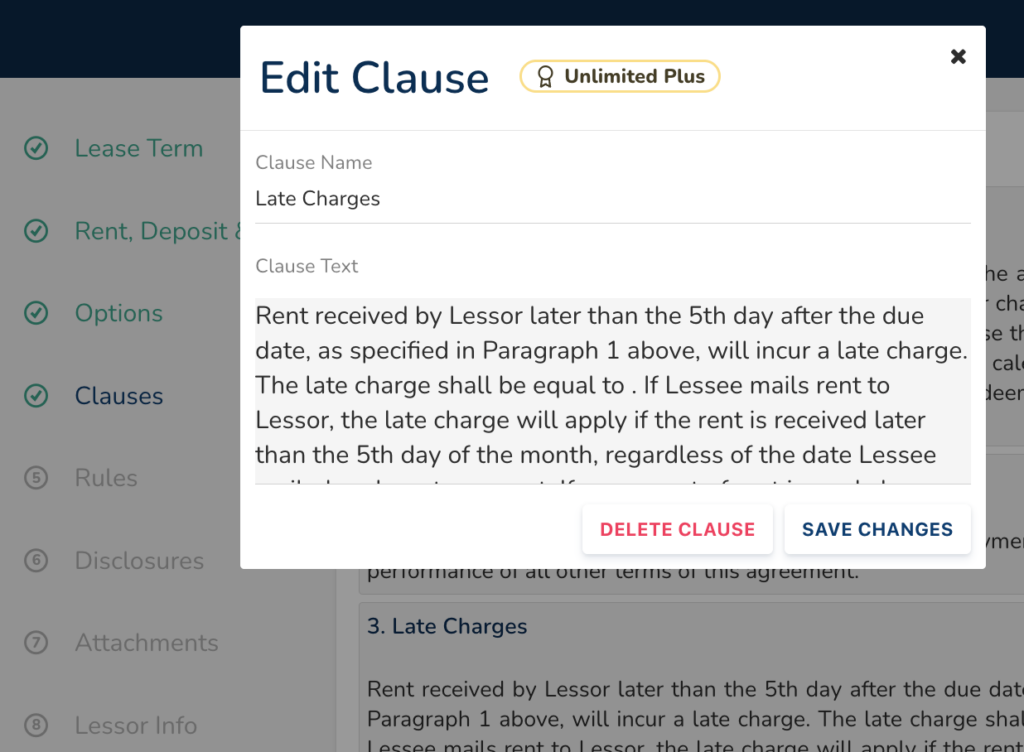
With Unlimited Plus, you can also clone and reuse your customized leases across all units to save valuable administrative time.
3. Collect Free Digital Signatures
Printing, scanning, and mailing physical paperwork create unnecessary operational delays. Avail allows you to send agreements directly to your prospective tenants for seamless, secure electronic lease signing.
Digital signatures are completely free for both parties, and you can track the signing progress in real-time right from your centralized account dashboard. Once fully executed, your digital leases are stored safely inside your account for hassle-free online property management.
Create and Sign State-Specific Rental Lease Agreements for Free
Build locally-compliant rental lease agreements or upload your existing lease to sign online at no additional cost.
Get Started for FreeFrequently Asked Questions: Month-to-Month Leases
What Notice Is Required to End a Month-to-Month Lease?
Most states require 30 days’ written notice to end a month-to-month lease, though the mandatory period can range anywhere from 15 to 60 days, depending heavily on state statutes and local municipal regulations.
Always review your specific lease clauses and confirm your local tenant laws for the exact requirements.
Can Landlords Raise Rent During a Month-to-Month Lease?
Yes, landlords possess the legal right to raise the rent on a month-to-month lease, but they must provide advance written notice as dictated by state law, which is typically 30 days.
Because the rental agreement contractually renews every month, rent adjustments can occur far more frequently than they do under a traditional fixed-term lease.
What Are the Main Risks for Tenants With a Month-to-Month Lease?
The most significant risks for renters include unexpected rent increases, the possibility of the landlord ending the lease on short notice, and a general lack of long-term housing stability compared to an annual agreement.
Renters should budget carefully for potential premium pricing and maintain a clear backup housing plan.
How Can Landlords Manage Higher Turnover With Month-to-Month Leases?
Landlords can effectively mitigate the operational impacts of frequent turnover by performing thorough tenant screening, streamlining their move-out and move-in inspection processes, proactively maintaining the property, and keeping a dedicated vacancy reserve built directly into their operating budget.
Make Month-to-Month Leases for Free
Managing month-to-month rental arrangements does not have to be an administrative headache. Whether you are a DIY landlord executing your very first rental tenancy or a renter carefully reviewing your upcoming tenancy rules, having the right framework ensures complete legal protection and peace of mind.
Avail offers state-specific, lawyer-reviewed lease agreement templates designed to comply fully with local rental laws. Our easy-to-use platform allows you to customize your terms, add personalized rules, and secure legally binding e-signatures online for free — no printing required.
Beyond document creation, Avail seamlessly integrates tenant screening tools, automated online rent collection, and digital maintenance tracking to simplify every single step of your property management journey.
The information provided on this website does not constitute legal advice. This is for informational purposes only. Please consult with a legal professional for additional information.

- Advertise your rental online
- Collect rent online and more
- Access lawyer-reviewed lease agreements