Should I Sell or Rent My House?


Deciding whether to rent or sell your house is one of the biggest financial decisions a homeowner can face. No universal right answer exists, as the best choice depends on your financial goals, the local market, the property itself, and your appetite for being a landlord.
This article walks through every factor — from equity math to the IRS residence test — so you can make a confident, informed decision.
The Importance of Establishing Your Financial Goals For The Property
Personal financial situations serve as the single most important starting point for this decision. As a homeowner, you must clarify your immediate cash needs, long-term wealth building goals, and existing mortgage terms.
Understanding The Renting Vs. Selling Trade-Off
Selling can provide a lump sum, while renting can provide steady income. Choosing to sell transforms home equity into immediate liquidity, which often assists with a down payment on a new home or provides capital for other investments.
In contrast, keeping the property as a rental establishes a source of monthly cash flow and allows you to benefit from long-term property appreciation. This can also act as a wealth-building engine that pays down the mortgage via tenant rent while the owner retains the underlying asset.
Equity And Mortgage Dynamics
Equity represents the portion of the property you truly own, calculated as the difference between the home’s market value and the mortgage balance. Higher equity levels generally make selling more profitable, particularly in favorable markets.
Many homeowners currently hold mortgage rates below 4%, which complicates the decision to sell since replacing that rate on a new purchase would be significantly more expensive. Average 30-year fixed mortgages is around 6.56% as of June 2026, creating a massive gap in borrowing costs. If high mortgage costs leave no room for monthly profit, renting may not be a viable financial strategy.
Financial Self-Assessment Checklist
If you’re unsure on whether to rent or sell your home, consider these key questions:
- Do you need the sale proceeds for a down payment on your next home?
- Is your priority monthly cash flow or a one-time payout?
- Do you want a long-term investment that builds wealth over time?
- Could you absorb a few months of vacancy or unexpected repairs?
Is The Local Market Better For Renting Or Selling?
Market conditions can tip the scales decisively toward one path, requiring homeowners to study local data rather than national headlines. Seller’s markets maximize sale prices, whereas a slow market may favor renting until property values improve.
| Signs Selling May Be Better | Signs Renting May Be Better |
|---|---|
| High buyer demand and low inventory favor a high historical sale price. | Strong local rental demand exists near colleges, medical hubs, or job centers. |
| Home prices are at or near their peak in your specific local neighborhood. | Soft sales market or declining prices make a traditional sale less profitable right now. |
| You need a lump sum now for a down payment, business equity, or liquid reserves. | You can cover carrying costs with rent, producing stable monthly cash flow. |
| You are relocating permanently far away and do not want long-distance management duties. | You may return to the area later and want to keep a foothold in the local market. |
Urban areas, college towns, and job-growth markets often experience the strongest rental demand. Homeowners should research local vacancy rates, average rents, and neighborhood population trends.
Tools like Realtor.com My Home tracks all of this for your specific address in real time. You can stay ahead of your local market with real-time trends, recent sales, and data on what homes like yours are worth in your neighborhood.
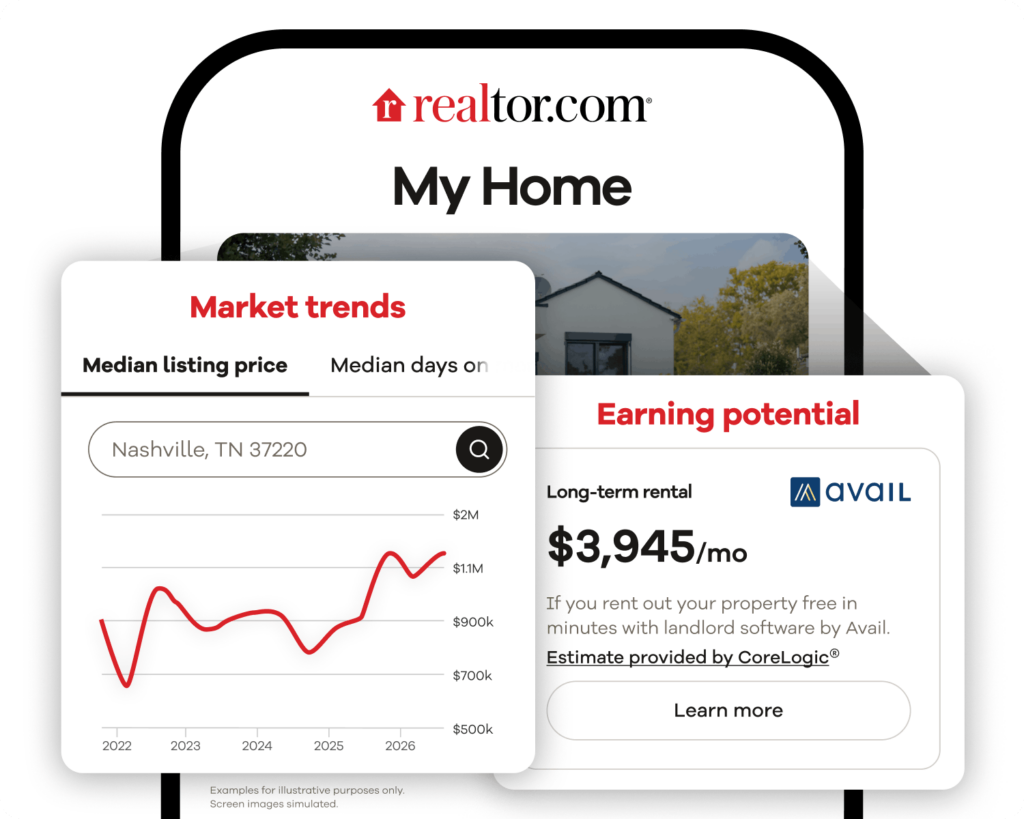
To access these tools, you’ll need to claim your home. Claiming is free and takes just a few minutes — and it’s what unlocks the full dashboard for your specific property.
How Do I Determine If My House Is A Good Rental?
Not every home serves as a high-performing rental property. It’s important to honestly evaluate whether your house has the specific features tenants prioritize or if the physical layout makes management difficult.
Identifying Rental-Ready Features
Properties often perform better as rentals when they include features that attract high-quality tenants. These desirable characteristics include:
- In-unit laundry or washer/dryer hookups which increase convenience for modern renters
- Dedicated parking or a private garage to provide security and ease of access
- Functional layouts that offer adequate storage space for tenants
- Outdoor spaces like yards, patios, or balconies that expand the living area
- Close proximity to transit, highly-rated schools, or major employment centers
How Much Will Make-Ready Costs Impact Profit?
Selling may be the better move if a home is not in rental-ready shape. Consider obtaining estimates for necessary repairs and weigh those costs against the projected rental income.
If renovation expenses take years to recoup through rent, selling often delivers a better short-term return.
What Are The Responsibilities Of Being A Landlord?
Becoming a landlord involves a significant commitment that extends far beyond collecting rent checks. Landlords must handle a variety of administrative and operational tasks to maintain a successful rental. These duties look like:
- Tenant screening: This involves running credit, criminal, and eviction reports to ensure applicants are reliable.
- Lease management: Owners must create state-specific, lawyer-reviewed lease agreements and enforce the terms consistently.
- Rent collection: This requires establishing a secure system for monthly payments and handling late fees if necessary.
- Maintenance coordination: Landlords must respond to repair requests, track progress, and keep digital records of all property work.
- Legal compliance: Property owners must adhere to fair housing laws and local landlord-tenant regulations to avoid legal disputes.
Landlord software platforms like Avail offer streamlined tools specifically for DIY landlords, including TransUnion® screening, lawyer-reviewed leases, and online rent collection. If you move out of the area, hiring a property manager is an alternative, though their fee typically ranges from 8% to 12% of the monthly rent.
Manage Your Rentals With All-In-One Landlord Software
Listings, screening, leases, rent payments — all in one simple dashboard. No more scrambling to remember which app does what.
Get Started for FreeWhat Are The Main Factors To Consider For Both Routes?
Deciding whether to rent or sell requires a balanced evaluation of market timing, financial liquidity, and personal lifestyle preferences. This section distills the complex variables discussed throughout this guide into a direct comparison to help clarify which path aligns with your current priorities.
Side-By-Side Comparison: Renting Vs. Selling
The following table outlines the typical indicators that favor one decision over the other based on common homeowner scenarios:
| Factor | Signs Selling May Be Better | Signs Renting May Be Better |
|---|---|---|
| Market Condition | High buyer demand and low inventory favor a high sale price. | Strong local rental demand exists near colleges or job hubs. |
| Financial Need | You require a lump sum for a down payment or other debt. | You prefer a long-term investment that builds monthly wealth. |
| Property Values | Home prices are at or near their peak in your neighborhood. | The sales market is currently soft or prices are declining. |
| Current Mortgage | You have little equity or a high interest rate you wish to exit. | You have a low mortgage rate (below 4%) that is worth keeping. |
| Future Plans | You are relocating permanently and prefer a clean break. | You may want the option to move back into the home later. |
Once you identify which column better describes your situation, you should move toward more concrete data points. If selling seems likely, obtaining a comparative market analysis (CMA) from a local agent is the professional standard for determining your home’s worth.
If you’re starting to think about selling, RealEstimate℠ on Realtor.com My Home is a smart first step. It pulls from three independent, third-party sources — giving you an unbiased read on what your rental property is actually worth today, for free.
What Are The Tax And Legal Implications?
Tax rules can dramatically change the financial outcome of renting versus selling. These concepts help homeowners understand potential liabilities, though they should always consult a tax advisor for personalized guidance.
Understanding Capital Gains And Depreciation
A primary residence may qualify for a gain exclusion of up to $500,000 for married couples or $250,000 for single filers.
- IRS Capital Gains Exclusion: Allows homeowners who lived in their primary residence for at least 24 out of the last 60 months to exclude significant profit from capital gains tax upon sale.
Renting the home for too long before selling can cause you to lose this exclusion entirely. Additionally, landlords can deduct depreciation on the property, but the IRS “recaptures” that depreciation at a rate of up to 25% when the property is eventually sold.
Legal And Mortgage Checkpoints
Homeowners should verify several legal factors before converting a property to a rental:
- Verify you meet the IRS residence test before conversion.
- Check mortgage terms for owner-occupancy requirements that might restrict renting.
- Review local landlord-tenant regulations and required disclosures.
- Confirm any HOA restrictions on rental properties.
Once these steps are complete, homeowners should consult a CPA to model after-tax outcomes. If the results are favorable, the next phase involves preparing the property for tenants and researching local rental rates using tools like Realtor.com.
Frequently Asked Questions: Renting vs Selling Your Home
Should I Rent Or Sell My House?
This decision depends on your financial goals, local market conditions, and your willingness to be a landlord. Selling provides a lump sum, while renting offers ongoing income and long-term appreciation.
Will The Rent Cover My Mortgage And Other Costs?
Ideally, rental income should cover the mortgage, taxes, insurance, maintenance, and any management fees. If the expenses exceed the rent, the property may not be a sustainable investment.
Is My Local Market Better For Renting Or Selling?
Strong home prices and buyer demand favor selling to maximize returns. Conversely, soft sales markets with solid rental demand—often found near job hubs or universities—may make renting more attractive.
Can I Lose My Capital Gains Exclusion By Renting First?
Yes, the IRS requires you to have lived in the home as your primary residence for 24 of the last 60 months before the sale. Renting the property for too long can disqualify you from this tax break.
Manage Your Rental With Confidence
Deciding to rent your home is the start of a significant wealth-building journey, and you don’t have to navigate it alone. Join the 1 million+ landlords who use Avail to responsibly manage their properties with professional-grade tools built specifically for DIY owners.
Whether you need to syndicate your listing to the top rental sites, run TransUnion® tenant screenings, or set up automated rent collection that deposits directly into your bank account, Avail provides the guidance and support you need to save time and stay organized.
The information provided on this website does not constitute tax advice. This is for informational purposes only. Please consult with a tax professional for additional information.
- Advertise your rental online
- Collect rent online and more
- Access lawyer-reviewed lease agreements