How to Use Rental Market Data to Set a Competitive Rent Price


The key to setting a competitive rent price is knowing how to use the right rental market data. This is because using a detailed analysis of local rental comps can help identify what an appropriate rent price looks like and how to balance profitability with tenant retention.
With that in mind, this article outlines the core components of local real estate metrics, steps to find and filter accurate neighborhood comparables, and how to use rental market data to set the right rent price for your rental property.
What Is Rental Market Data and Why Does It Matter?
Rental market data consists of localized statistical metrics including median rent prices, historical and current neighborhood vacancy rates, and average days on market. As a landlord, it’s important to review these indicators to price units based on verifiable local parameters rather than guesswork.
Plus, accurate numbers protect your business from the compounding financial damage of a prolonged vacancy. For example, if you price your unit too high, this can drive away qualified prospects, while pricing it too low leaves significant money on the table.
Leveraging rental market data establishes a predictable way to measure what local renters can actually afford.
How to Find and Filter Comparable Rental Listings
You find and filter comparable rental listings by identifying properties inside your immediate neighborhood that match your unit’s exact layout, bedroom count, and bathroom configurations. This information can be found by visiting popular rental sites that include up-to-date listings.
To accelerate this process, consider purchasing an Avail Rent Analysis report to unlock a comprehensive, six-page market study tied directly to your property’s street address.
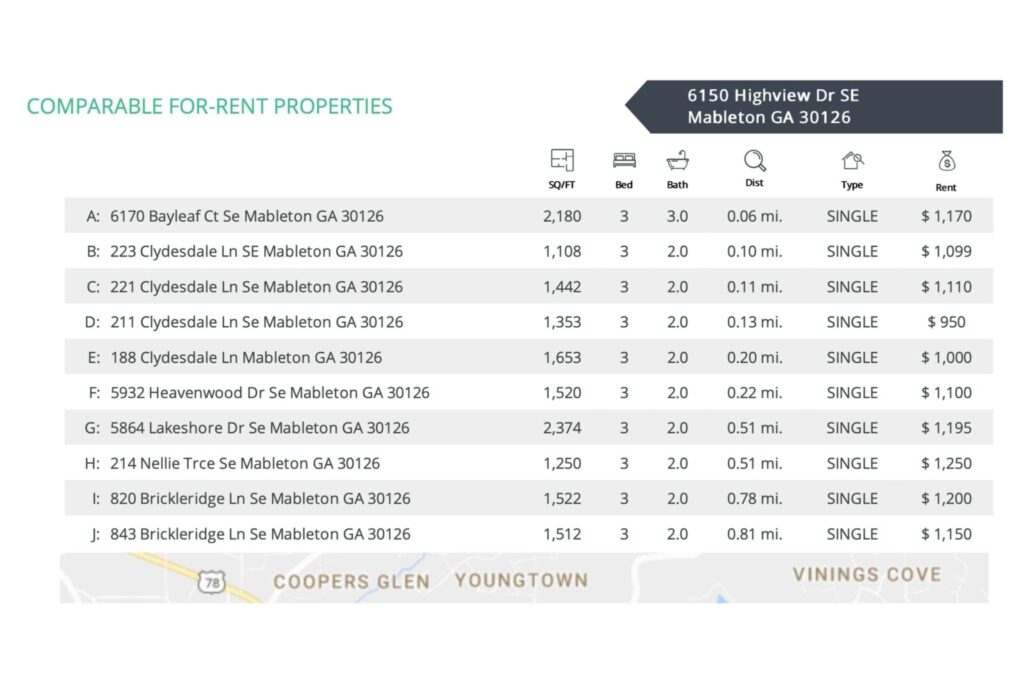
This detailed report eliminates hours of manual research by delivering a data-backed rent estimate, a local pricing confidence score, neighborhood vacancy rates, historical trend lines by bedroom count, and a map of the 10 closest comparable properties with their exact leased rates.
Free online rent calculators typically pull generic averages from massive geographic zones, meaning they completely overlook hyper-local demand shifts, asset conditions, and property types. That’s why investing in a professional report removes the financial risk of mispricing by giving you an accurate, defensible baseline that protects your monthly cash flow.
Set a Competitive, Data-Backed Rent Price
Easily access local rental comps, market trends, rent price changes, and more with an Avail Rent Analysis report.
Get Started for FreeThe Top Rental Market Data Points to Analyze When Setting a Rent Price
The key data points to analyze when setting rent are localized median asking prices, current vacancy rates, and average days on market, all of which are covered in most rent reports.
Below is an overview of each to better understand why they matter the most:
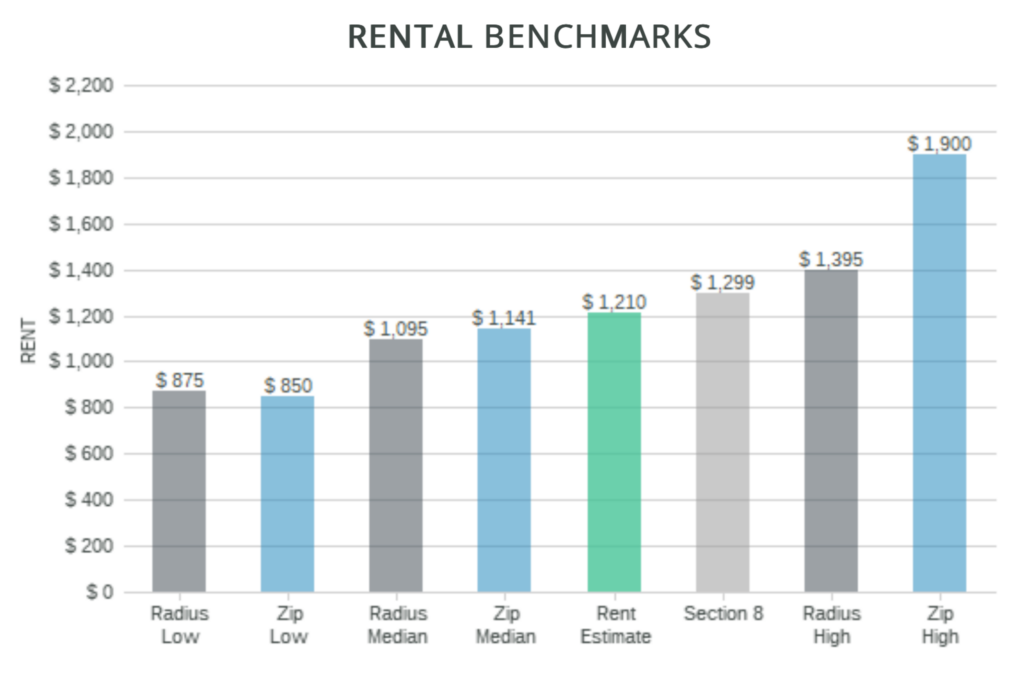
- Rental benchmarks and asking prices: This baseline section details the highest and lowest historical prices inside a one-mile radius and your specific ZIP code. These numbers gives you an absolute floor and ceiling for room counts across different spaces, which can be helpful for when you need to price a studio for rent or a sprawling multi-family unit.
- Days on market vs. vacancy trends: This visual tracking feature plots an annual county-level bar-and-line chart showing exactly how long regional properties sit empty alongside live vacancy rates. Units that lease within 14 days flag a hot market where you can price more aggressively, while historical periods extending past 30 days alert you to temper your expectations to avoid carrying a costly vacant property.
- Historical and geographic trends: This analysis highlights multi-year rental trends across your city, county, and state, tracking growth alongside local single-family property saturation rates. Knowing if your area has higher renter occupancy vs. census baselines lets you optimize your pricing moves across varying seasons.
Get these metrics specific to your property with an Avail Rent Analysis report.
How to Use Demand Signals to Stress-Test Your Rent Price
To stress-test your rent price, monitor seasonal timing shifts and initial applicant response volumes during the first week your property goes live. Pay attention to these active signals to know when to pivot your numbers before a vacancy becomes expensive.
High seasonal demand occurs during late spring and summer, allowing landlords to price closer to the top tier of the market. Conversely, winter listings often require a slightly lower price point to secure tenants.
How to evaluate your early listing performance:
- Benchmark healthy interest: On average, live listings across the ecosystem pull in 6.61 renter leads* within 30 days. If you are tracking well below this pace after your first week live, your price point is likely out of sync with current market demand.
- Don’t stay passive: Platform survey data reveals that when facing a lack of renter inquiries or prolonged vacancy, 83.3% of independent landlords* take active intervention — with 24.1% choosing to lower base rent directly and others adjusting secondary costs like move-in fees to increase visibility.
If your property receives zero viewing requests within seven days of publishing, take a page from experienced landlords: adjust your numbers quickly to capture active renter interest before a quiet listing turns into a costly vacancy.
Frequently Asked Questions: Rental Market Data
What Rental Market Data Should I Use to Set a Competitive Rent Price?
To set a competitive rent price, use a combination of recent neighborhood comps, local vacancy rates, historical trends, and average days on market. These metrics ensure your pricing aligns with local conditions and tenant budgets.
How Do I Find Comparable Rental Listings Near Me to Price My Property?
You can find comparable listings by utilizing online property search tools or data-driven rent analysis reports like Avail’s to isolate rentals inside a one-mile radius with matching bedroom and bathroom counts.
How Do I Determine a Rent Price for My Property?
Determine a rent price for your property by collecting active neighborhood listing averages, analyzing seasonal demand spikes, and adjusting up or down for your unit’s specific upgrades.
For example, let’s say you own a three-bedroom single-family home with a baseline neighborhood median rent of $1,200 per month. If a manual search or your custom rent report reveals that nearby properties lack private parking and modern kitchens, you can comfortably add a pricing premium to your rate.
Allocating an extra $50 for your dedicated driveway and $50 for new stainless steel appliances allows you to mathematically justify a final price of $1,300. This step-by-step calculation ensures you maximize your monthly cash flow without accidentally pricing yourself out of the local market.
How Do Landlords Conduct a Rental Market Data Analysis?
Landlords conduct a rental market data analysis by reviewing automated address-specific property insights, comparing localized radius benchmarks, and evaluating neighborhood vacancy trend charts.
To do this yourself, run through a comprehensive market analysis by evaluating your custom report pages chronologically:
- Examine your Rent Estimate and Confidence Score: Look first at the primary page of your report to find your subject property’s tailored monthly rent recommendation. This automated figure is powered by professional RentRange valuation software and features an explicit confidence percentage based on live neighborhood sample sizes, giving you an immediate, defensible target rate.
- Review Local Comparable Map metrics: Scroll to the comparable properties section to study the side-by-side data table and interactive neighborhood map. This layout pins the 10 closest for-rent properties, allowing you to cross-reference their exact bedroom counts, bathroom tallies, square footage configurations, and final leased prices inside a tight one-mile radius of your front door.
- Study County-Level Vacancy and Saturation benchmarks: Check the historical bar-and-line charts to gauge how your local inventory moves throughout the year. This data layer details average days on market alongside local ZIP code saturation counts, revealing whether your neighborhood contains a dense pool of active renters or if local properties are sitting stagnant.
- Calculate your final upgraded value: Take the median radius benchmarks from your report and adjust your final number to account for property-specific upgrades. If your report shows that the nearest properties lack private driveways or updated appliances, you can comfortably add a small pricing premium to your monthly asking rate.
By doing this exercise, you can get an accurate, highly localized baseline that protects your investment portfolio from expensive pricing errors. Once you complete this report walkthrough, you can begin creating your listing to market your rental online.
What Are the Best Tools to Compare Rental Listings in My Area?
The best tools to compare rental listings include automated pricing engines, local MLS databases, and data-informed reports like an Avail Rent Analysis report. Leveraging dedicated platforms provides comprehensive market metrics that general real estate portals often miss.
How Can I Research Rental Prices in My Neighborhood?
You can research neighborhood rental prices by running comparative property searches within a one-mile radius and logging local asking rates for similar square footage configurations.
Where Can I Find Free Rental Comps for Landlords?
You can find free rental comps by manually browsing active local housing databases and recording rates for units with matching bedroom counts. Independent property managers use this baseline information to cross-reference their own price points against budget rental options.
How Do I Know If My Rent Is Above or Below Market Value?
To determine if your rent is above or below market value, compare your rate to active listings for similar properties (comps) in your immediate neighborhood. Look at properties with similar square footage, bedroom and bathroom counts, unit type, and offered amenities.
Key indicators to evaluate include:
- Above Market Value: Your rental unit sits vacant longer than the local average days on market, receives minimal lead volume, or prospective renters consistently request price concessions.
- Below Market Value: You receive an overwhelming number of rental applications within 24 to 48 hours of listing, or your price per square foot is significantly lower than neighboring comps.
- At Market Value: You generate a steady stream of qualified inquiries, schedule regular property tours, and secure a qualified tenant within two to three weeks.
Pro Tip: Investing in an Avail Rent Analysis report gives you instant access to local rent comps and neighborhood trends. The report specifically calls out the radius low, medium, and high rent prices so you have a clear pricing range to set your target rate.
What Is the Best Way to Test New Rent Prices Before Listing?
The best way to test new rent prices is to launch your listing and closely monitor performance during the first 48 to 72 hours. Tracking early interest allows you to evaluate whether your price point is realistic before committing long-term.
Follow these steps to test pricing effectively:
- Publish an initial listing: Post your property at your target maximum rate across top rental platforms to gauge initial demand.
- Monitor the 48–72 hour window: Track both the volume of inbound leads and the quality of interested renters (e.g., whether leads meet basic income, credit, or rental criteria).
- Adjust pricing promptly: If lead volume is low or interested applicants do not meet your screening criteria after three days, lower the asking rent in small increments (such as 2% to 3%) until you attract qualified prospects.
How Can Landlords Forecast Rental Price Trends?
Landlords can forecast rental price trends by reviewing comprehensive market analysis reports and tracking macro-level economic shifts alongside local inventory movements. Combining regional macro trends with micro-level property data provides the clearest outlook for annual rate adjustments.
To build an accurate pricing forecast, leverage these two core resources:
- Review the complete Avail report: Generate an Avail Rent Analysis report to establish a data-driven strategy. A complete report evaluates all key variables — including local rent comps, county-level price trends, historical growth, and local vacancy benchmarks.
- Track macro trends via Realtor.com: Reference the Realtor.com Monthly Rental Report to monitor high-level rental price trends across top metropolitan areas. Tracking these national and regional shifts helps you anticipate broader market softening or demand spikes.
How Can I Automate Rent Price Analysis Each Year?
You can automate your annual rent price analysis by utilizing all-in-one landlord software integrated with real-time market data engines. Using automated property management tools eliminates manual spreadsheet tracking and ensures your portfolio stays aligned with current market values.
Here is how to automate your annual pricing workflow:
- Schedule Automated Market Reports: Generate a digital Rent Analysis report annually to pull updated neighborhood comps, radius low/medium/high ranges, and regional market trends directly into your account.
- Sync Financial Records: Connect your property management accounting tools so historical rent charges, income, and cash flow sync automatically with your pricing model.
- Set Recurring Renewal Milestones: Automate lease renewal notifications 60 to 90 days before lease expiration, pulling fresh local comps to present updated, market-rate renewal offers seamlessly.
Get a Custom Rent Estimate with Avail
Advertising your rental property online is the fastest way to put your newly optimized rent price in front of eager renters. Easily manage this entire process and take the guesswork out of pricing by using an Avail Rent Analysis report. Our comprehensive, data-driven report strips away the mystery of local real estate trends by compiling essential local metrics for your exact street address.
Every professional report delivers actionable market intelligence, including precise rent estimates, localized rental benchmarks, county-level trend tracking, and more. Create an Avail account today to purchase a Rent Analysis report to price your unit with absolute confidence.
*Lead and landlord action metrics reflect Q2 2026 platform averages and survey results among independent housing providers. Individual performance varies by local market.
- Advertise your rental online
- Collect rent online and more
- Access lawyer-reviewed lease agreements